Tuesday, 9 April 2019

Migraines in Children - Steven Leber , MD Ph.D. Pediatric Neurology

Migraines in Children 
Migraines in Children - Steven Leber , MD Ph.D. Pediatric Neurology - 2018 Partners in pediatric Care CME - C.S. Mott Children's Hospital  Migraines in children: Guidelines for primary care management of headache


Differential Diagnosis of Different Types of Headache in children  
So when we're talking about headaches in kids, there's no disclosures here, it's very easy for us to makes lists like this of what's a primary headache and what's a secondary headache. Where a primary headache is if you treat the problem, you've got it solved, whereas a secondary headache is a headache that's due to an underlying cause and you really have to find the cause. 

Primary Headache : 

 Most of the headaches we see in kids are migraine headaches. We'll come to tension-type headaches. It's very, very unusual to see cluster headaches in kids. 

Secondary Headache : 

Secondary headaches are fairly common. 
Most of the time they're fairly easy to recognize. 

  • And probably the most common we see is because of depression. 
  • When people have sinus disease it's usually fairly straightforward. 
  • Tumors and mass lesions we'll talk about in terms of increased intracranial pressure, similar to with hydrocephalus. I'm not gonna have enough time to talk about pseudotumor. But these all present with increased intracranial pressure. 
  • Meningitis is again usually fairly straightforward with a stiff neck and meningeal signs. Although these might not be present in kids under two years of age. 
  • Subarachnoid hemorrhages happen in kids, they're much less common than adults. But if you do see a sudden onset of a worst headache of somebody's life, then you have to think about it. Usually you can diagnose it with CT scan, but about 8% are missed and you need an LP for that. 
  • Seizures commonly have headaches postictally. So it's not unusual for a child who has a seizure to have the seizure resolved and have a headache. It's fairly unusual for a headache to be the sole manifestation of a seizure. And it tricks us sometimes because the headaches tend to be brief, come and go periodically throughout the day. But most of those headaches that come for a few seconds or a couple minutes and go away, are really benign headaches. And we see them pretty commonly in kids. In young kids we see those waking the kids up at night. 
  • Temporomandibular joint dysfunction can present with headaches but perhaps more commonly, headaches can result from teeth clenching. If you keep your fist contracted for an hour, you build up lactic acid, you get headaches. The same thing with people clench their teeth at night. It's sort of a reflex when somebody, a kid presents with a headache to send 'em to an eye doctor to get their refraction checked. That's pretty unusual as a cause of a headache. If you do cross your eyes, your pupils constrict, your depth of focus increases, like you're stopping down an aperture of a camera and you can see better and that can give you a headache. 
  • But most kids don't do that. On the other hand, sleep problems are real common causes of headaches. Kids not getting enough sleep, sleeping poorly. 
  • High blood pressure can cause headaches, but it also can result from increased pressure. And then, more and more kids are drinking lots of caffeine energy drinks and withdrawal can cause seizures, headaches. 
Signs of Increased intracranial pressure :


  •  Classically you have progressive headaches that worsen with lying down. 
  • Because there's high pressure, they wake you at night and are present first thing in the morning. 
  • They can be associated with mental status changes. 
  • Nausea and vomiting, but though these are really not specific 'cause we can see those with migraines. 
  • And obviously papilledema. 
  • You can get a sixth nerve palsy, reminding you the sixth nerve controls the lateral rectus so your eye tends to go inward because you can't abduct the eye. This is a false localizing thing as sixth nerve gets compressed or stretched.
  •  In infants who have high pressure, they can develop macrocephaly or bulging fontanelle, 
  • Or can have something called sunsetting in which the pressure in the midbrain keeps their eyes from going up, so it looks like their eyes are setting in their orbits. 
Tension-type headaches:

Tension-type headaches, we don't say tension headaches anymore because the muscle tension actually isn't increased, but classically as a diffused band-like headache. 
Described as aching, kind of non-specific complaints. 
Often resolved with minor over-the-counter analgesics. Typically no nausea or vomiting but increase with stress. But the increase with stress is certainly not specific. That happens with migraines. 
Migraine with aura. 
So about 10 or 15% of migraineurs have an aura. They don't have to have it with every headache. 
  • An aura is a neurologic dysfunction. So it can be a negative thing, I lose my vision or get blurry vision, or a positive phenomenon, I see things that aren't there, sparkles, dots, zig-zag lines. If they have a unilateral headache, the aura is usually contralateral to that. And visual symptoms resulting from occipital involvement are most common, but you can have sensory, motor, language, cognitive, or cerebellar dysfunction.  
  • The visual symptoms. Classically you have, this is where you're looking, a zig-zag line that's expanding and leaves a scotoma behind. 
  • But you can get sensory, motor, or language like I mentioned. 
  • The headache is usually throbbing. In adults it's classically unilateral. In kids it's more commonly bilateral. It can be frontal or temporal, although sometimes we see them occipitally. Gradual onset, going on over minutes to hours. Classically two to six hours. Usually it's shorter in children than adults. And classic for migraines, activity worsens the headache. So running in gym class, going up stairs. And it's very classic for sleep to improve the headaches. Even sometimes a nap. 
  • A lot of GI symptoms, loss of appetite, nausea, vomiting. 
  • They can get very tender to non-specific things. So somebody has a migraine, you touch their forehead, it hurts. That's a phenomenon called allodynia. 
  • And then very classically, photophobia or phonophobia. Light or noise sensitivity, one or both, but not always. 
Migraine without aura

  • Migraine without aura is more variable. 
  • There's often personality changes, a vague dizziness, malaise. 
  • The headache may be unilateral and pounding, often hard to describe. Again can go on for variable periods of time. And classically when somebody has a migraine with aura, they throw up, they feel better. With migraine without aura, that tends not to happen.
 Triggers of Migraine : 

  •  Triggers, most of the time people have migraines, there's no specific trigger. But the ones we see are stress, head trauma. 
  •  But even without a concussion, just lightly bumping your head can bring on a migraine, heading a soccer ball. Certain foods, that's fairly uncommon. 
  • When they're doing careful studies, maybe 10 or 15% have a specific food trigger. 
  • Menstrual cycle, so 60% of women have worsening of their migraines with their periods. And 15% have exclusively with their periods. Even if you get enough sleep, changing your sleep habits will often bring on migraines. So staying up late Friday night and Saturday night, bringing on headaches later. 
  • Missing meals is classic. 
  • And then certain odors such as perfumes, very classic for bringing on headaches. 

Family history.

 So if you had to guess, what percent of children with migraines have a family history of one or both parents? Just think about it for a second. It turns out to be 80 or 90%. Now the issue is getting the history. 
So I can't tell you how many times I've asked, Does anybody get migraines? The answer is no. Well I'm gonna start Billy on medicine X. Well that didn't work for my migraines. I thought you didn't get them?Well, I don't, I used to. Or, I don't get migraines, I get sinus headaches. I get sick to my stomach, I see sparkles and lights and noise bother me but it's because of my sinuses. So you really have to ask, does anybody now get headaches or get headaches in the past? 

Migraine variants : 

  • The other things that's specific to pediatrics or more common in pediatrics is migraine variants. A lot of what we see aren't really presenting with the headaches as much as other things. We talk about complicated migraines as migraines with a non-visual aura. 
  •  So any of the other things that we talk about, there's ocular migraines, in which you lose vision in one eye. Most of the people that come in and say, I had a headache and I lost vision in my right eye, are really talking about a right hemianopsia. It's the same if you cover the right eye and left eye. Occasionally have a very astute kid comes in and says, I lost vision in my right eye. I could see perfectly well when I cover my right eye, and I'm totally blind when I cover my left eye. The retina's involved in the migraine. The retina we can think of as part of the brain. 
  • Opthalmoplegic migraine affecting the cranial nerves. 
  • Basilar migraines are very common, they often present with syncope. So it's two or more brain stem features. So loss of consciousness, your reticular activating system keeps you awake. Ataxia, tinnitus, double vision, the brainstem keeps your eyes aligned. Bilateral sensory symptoms as the fibers come up from your neck. We see kids with acute confusional migraines. It's basically up to 24 hours of delirium. Come to the ER, can't tell if they're have encephalitis or complex partial seizures. Then it becomes clear it's a migraine. 
  • You can get an aura without a headache, so the visual changes or vertigo is one of the common presentation. One of the common causes of vertigo in kids is migraines. 
  • Certain genetic things can cause hemiplegic migraines that run in families. 
  • Trauma-induced migraines. The British literature is full of people who headed a soccer ball and went blind for an hour, with our without a headache, and it's a migraine aura with that, they may not have a headache. 
  • There's something called benign paroxysmal vertigo. It seen in infants. So they may all of a sudden fall to the ground, look terribly distressed. The astute mother may notice the eyes are going boom, boom, boom, boom, there's nystagmus. Goes on about 10 minutes. If the kids are old enough, they may say they're dizzy. And then it goes away. They often have a family history of migraine. Often evolve into more typical migraines. 
  • Similarly there's something called benign paroxysmal torticollis, where, oops, skip that, where kids are like that for a day or two. They're terribly distressed, they're vomiting, and goes on and may evolve into more typical migraines. 
  • And then cyclic vomiting. If people who have migraines often present initially with just a lot of vomiting, evolve into migraines. About half the cyclic vomiters, are migraineurs, it's hard to know, so it's a matter of treating them. But if it doesn't work, you don't have a diagnosis, because the treatment doesn't work for everything. 

 Complications of migraine. 

  • So just real quickly, status migrainosus is having a migraine going on for 72 hours. Different from people who have chronic, daily headaches. Kids often come to the ER with dehydration, vomiting. 
  • Migrainous infarction, so higher risk of having strokes if you have migraines, the reasons aren't clear. Sometimes they're tiny, little things like this. But sometimes they're bigger. 
  • Higher risk of cardiovascular disease in people with migraines but it's not clear why. 


Treatment  of Migraine: 

  • I'm gonna focus the rest of the talk on treatment. So a lot of it is reassurance. There's a huge amount of anxiety in kids and in parents of kids who come in with migraines. A lot of times just telling them this is not a brain tumor is enough to make the headaches better, because you're relieving anxiety. 
  • If there's clear precipitants, we try to avoid those. Every time you smell perfume, well don't smell perfume.
  • Avoiding Stress .
  •  Getting enough sleep, sufficient sleep. 
  • Abortives and preventatives.
Abortives and preventatives:

Abortive Migraine Medications :
  •  So just, these are better if you use at the onset. 
  • For most people, over-the-counter medications seem to work quite well. 
  • There are prescription medications, triptans that work quite well. Some are approved for kids, some aren't. Sometimes they're combined with naproxen. 
  • There's a number of combinations of various medications that seem to work well for migraines but sometimes not covered by insurance. 
  • And then the barbiturates such as butalbital seem to work but can cause kids to get really sleepy. 
  • A number of other medications. Occasionally we'll use narcotics but we really want to avoid those except in kids who maybe have, once or twice a year, killer headaches that nothing else seems to work, and then I'll use it for them. 
  • Steroids we tend to use for kids we can't break the headache. Sometimes they work, sometimes they don't. I'll use a five-day prednisone burst. 
  • And then we'll use a variety of antiemetics for kids who have a lot of vomiting. 
Prophylactic Migraine Medications :

  • Let's talk about a few preventative medicines. For a primary care doctor, what I would recommend is getting familiar with one or two preventative medications, getting comfortable using them and feel free to use them. We use preventative medicines in kids who have at least one or two headaches per week, particularly if they're moderately severe. 
  • We'll often use them for six to 12 months if the kids are doing well, then we'll taper the medications. 
  • I'll go through some of the medications we use, but we tend to use antihistamines, tricyclics, calcium channel blockers, seizure preventatives, and beta blockers. 
  • Cyproheptadine is the one that's the easiest to use. It's an antihistamine. It comes in a liquid, it comes in a four milligram tablet. Typical dose for a really little kid, start with two milligrams a day. It's usually divided BID, but because it makes people sleepy we sometimes just give it at bedtime. And it seems to work quite will there. The two main side effects are sleepiness and weight gain. Small kids seem to tolerate it better than teenagers. But if I have a very, very thin teenager who can't sleep, I'll often use it in that situation as well. It works quite quickly, so I'll sometimes use it when I really need to treat headaches urgently. 
  • Tricyclics either nortriptyline or amitriptyline. My sense is amitriptyline works better but has more side effects. Comes in a variety of pill sizes. Usually start, what I tend to do is I start low, because I don't want people to have side effects. Usually 10 milligrams at bedtime and build up weekly. I used to build up toward 75 milligrams at bedtime, and now I go toward 30. May have a month or two latency of onset. Lots of side effects, sleepiness, orthostatic hypotension, you can get dry mouth, weight gain, mood changes. The most dangerous side effect is arrhythmia so I really wanna make sure there's nobody, they're not suicidal, there's no little kids at home. And I'll, I tend to use them as a 1st line drug, but also in kids with chronic, daily headaches. I tend to get an EKG first. Ron can say whether it's cost effective or not. But what tends to happen is I build up to a large dose eventually and I see these little changes in the EKG. I'll go to the cardiologist, I'll say, "Is it from the tricyclic?" They go "I don't know, what'd it look like "before you started?" So I tend to get them but.
  • Topiramate is an anti-seizure medicine. It comes in tablets, sprinkles, you can make a suspension. We use much smaller doses of this for migraines than we use for seizures. So I'll tell a teenager I'm using what I use for a six month old with epilepsy. Large number of side effects. Most common are loss of appetite, and not sweating. But it can cause a lot of confusion, word-finding difficulty. You know, why did you put me on Stupimax? But I tend to use it as a 2nd line medication or in overweight patients because of the weight loss. 
  • We tend to use verapamil in kids. It doesn't work on adults. It can take a long time to work. I usually start it at 80 or 120 milligrams a day. The 120 has a long-acting form. Again, may take a month or two to work. The two most common side effects are orthostatic hypotension and constipation. And I tend to use it for complicated migraines, patients with non-visual auras although there's very little if any data to support that. And then there's a number of people who are using combinations of vitamins and cofactors. 
  • A number of commercially available combinations. People tend to use these when there's a preventative needed but really, parents, I don't want my kid on a medicine, but I can use a combination of vitamins. Not a lot of data about whether they work or not. What works best? So there's finally a multi-center trial called the CHAMP study published in the New England Journal in November 2016 comparing amitriptyline, topiramate, and placebo for migraine. Primary outcome was 50% reduction in headache days. Amitriptyline worked 52% of the time, topiramate 55% of the time, placebo 61% of the time.  Similar for all secondary outcomes. So we don't know what to do.  And they stopped it for futility. The people running this study still tend to use amitriptyline and topiramate. Maybe they weren't using enough in this study and we, you know, it's really unclear. A lot of the people in our group have gone to these vitamin and cofactors now. Because they say, well these medicines cause more side effects than placebo and they don't work as well so. But we just don't know. 
Chronic Headaches :

  • 20% of the migraineurs develop these chronic headaches. 
  • You get these patterns where these episodic headaches build up and there's a chronic headache going on. 
  • And they're often a combination of tension or mixed tension-like. 
  • They're often postconcussive, they have dizziness that's often vague, fatigue, missing a lot of school. And when these happen, you have to look for depression, psychosocial issues and abuse. And we really want to avoid the situation where they're taking, you know, acetaminophen or ibuprofen every day. And these are the situations, this was the trigger . 
    I was supposed to be using for behavioral interventions at this case, because that seems to work best in these patients. 
Behavioral treatments: 


- Let us  talk to you about a couple things that you might consider incorporating in your practice in terms of managing migraines that have very few to no side effects, so here we go with non-pharmacological management techniques. So the two categories I usually work in and recommend considering are optimizing either what we call the lifestyle factors, or headache hygiene factors in terms of managing their headaches. And in these I sometimes conceptualize it with patients like, think about it like a pie chart, like, all these different things are gonna be things that affect your headaches. Let's try to find the ones that are big ingredients for you, as well as anything that we can do to manage stress, to prevent triggers, or prevent this overall stress level that may be maintaining chronic headaches. So some of the lifestyle factors that we really consider like we've mentioned here all day are sleep, but also hydration, nutrition, getting regular physical activity, as well as considering medication adherence. Are the kids actually taking the medications they're prescribed regularly and with appropriate timing and doses. 

So I'll talk briefly about one of the main things that I find most complicated but very effective to help with migraines and that is addressing sleep. So we know that kids and teens these days are definitely overall not getting enough recommended sleep but there's been studies to suggest that the migraneurs and pediatric kids with headaches get less sleep even than their same-age peers. And what we also starting to understand is that the headaches can be correlated with the worse sleep. So as we're probably all expecting, this is likely bidirectional, headaches causing poor sleep, poor sleep causing headaches. The families or patients that are presenting to your office may have their own theory about the direction of that, but what we're starting to understand is really addressing the sleep, even though it may be viewed as an effect of the headaches, can actually really dramatically improve their outcomes. 

Optimizing Lifestyle Factors :

Sleep :

And it's important to recognize that these other behavioral interventions that we're gonna be considering, are less likely to be effective if these kids are sleep deprived. So some of the targets, we often talk about screen time. But other really helpful outcomes or targets to consider are the consistency. So like we've talked about a lot of kids have very disrupted sleep schedules between the weekends and weekdays, or are just like kind of all over the place. Like I don't normally go to bed around the same time, so trying to get them on a somewhat of a consistent sleep schedule can be really helpful. 

And sometimes that needs to be a gradual change as opposed to a sudden change. But I also like to make sure I don't underestimate the effects of conditioning with the bedroom and the bed. So some two recommendations to consider with kids are making sure that they are only using the bed for sleep. 

A lot of the kids will tell you, like, I do my homework in bed, and I do my Netflix in bed, and I'm Snapchatting in bed, and all that good stuff. And that creates an association with their bed and their bedroom that this is not a place for sleep. So it's a pretty powerful effect to remove all of that from the bed, only do sleeping activities in bed, and see if that starts to have an effect after done consistently for a little while. 

Similarly, a conditioning effect can occur when they're tossing and turning, having difficulty falling asleep at night or waking up frequently. So we try to break that cycle by getting the kids out of bed when they can't fall asleep. Engaging in a quiet, non-screen related activity and going back to bed when they are ready to go to sleep. So picking and choosing, experimenting and trying to find what recommendations work for them. And I do this process usually through just some simple motivational interviewing. Help engaging them in problem solving, as opposed to telling them what to do 'cause they've been told all over again to sleep better. So sometimes that gets you a little better success. 

Stress reduction : 
Relaxation and Biofeedback 

 Stress reduction is another big area that we consider with managing headaches and migraines through behavior. We really view this as a self-management approach. This is something that the child or teen can do for themselves to help their symptoms. And when practiced regularly, can actually, there's a meta-analysis a little while ago that showed that about 50% of outcomes were improved in about 50% of pediatric patients. So that was sometimes frequency or duration or intensity. Which a lot of these kids would view as a very significant improvement. 

So some common relaxation strategies that are taught and that I do with my patients are diaphragmatic breathing, progressive muscle relaxation, and some guided imagery, personalized to what works for them. You should know of course there are many apps, podcasts, things like YouTube clips and yoga can all be helpful as well. Many of you have heard about biofeedback and it's really exciting but I really try to remember that it is an adjunct to relaxation. It's not a tool that's gonna heal the child in and of itself. But what it does is it really provides either auditory or visual kind of feedback about what they're doing to their body when they relax. And it can be very empowering. It can help them understand what they're doing and motivate them to stick with it. 

So there's a number a variety of modalities that we use from pretty low tech to high tech. But all it does is it really shows the kid this is what you're doing to your body and we teach them a little bit about this is a mechanism, this is what's happening. And if you practice regularly, this is something that can be really be helpful for you. But again, it's that regular practice. 

When to refer to a Psychologist ???


  • So in our well-rounded, comprehensive treatment of headaches, you may at some point consider referring to a psychologist to help with persistent chronic or episodic headaches or migraines. 
  • Some of the things you might want to bring a psychologist on board to help with are things like, when they're not adhering to medication regimens. 
  • When they're avoiding a lot of school they say because of the headaches and migraines. 
  • If you already know or have identified presence of depression, anxiety, or other health conditions that may impact their headaches or how they treat their headaches. Or if the family just expressed an interest in non-pharmacological pain management, this is a great place to have a psychologist come out and help. 
  • So things like, I'm worried about my headaches, or my headaches are making me not perform as well in school. And when there's kinda mild depression or anxiety symptoms present. I can usually detect that by saying like, what are you stressed out about? As opposed to like, do you have anxiety disorder? 
  • But if depression or anxiety is much more generalized, pervasive, disruptive to life, that's when I would really consider primarily addressing those, and hopefully that will help address the headaches, and maybe pain psychology can be an adjunct to that but primarily kinda considering the depression or anxiety. 
Headache Evaluation : 


  • So when you're evaluating a headache what you wanna look at is blood pressure, the head circumference particularly a small kid. 
  • Whether they have sinus tenderness. You wanna do a good, careful neurologic examination, including looking in their eyes. 
  • Look for depression, look at sleep.
 When to image and when do you refer ???

  • And I don't know the right answers for all these. So we wanna do an imaging study, preferably an MRI, when there's an abnormal neurologic examination, when there's signs of increased intracranial pressure, that is the headaches are improving with sitting up or frequently wake the kids at night. Although I have to tell you, most of the headaches that wake people at night are migraines. 
  • When there's a progressively severe course, or even a change in the severity or the quality of the headache, so kids with migraines can develop brain tumors and we can't forget that. 
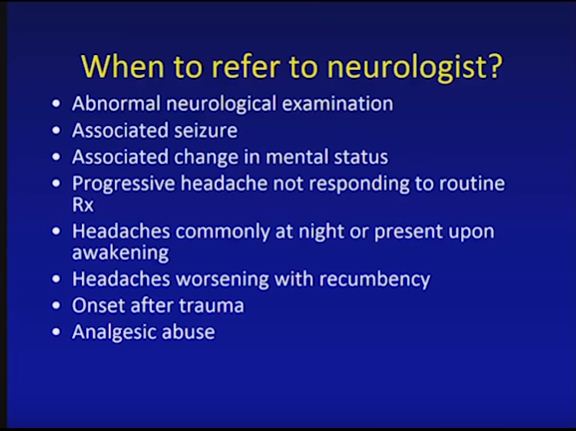
When do you refer to a neurologist? 


  • Abnormal neurologic examination, there's associated seizures, changes in mental status, things you're doing just aren't working. 
  • Other signs of increased ICP, onset after trauma or they're abusing analgesics. 
  • The role of the primary caretaker, I think you have to be able to diagnose migraines and know when the headache is more worrisome than being a migraine. 
  • Know when to image and when to refer or do one or the other. 
  • Be familiar with abortive medications and I would say at least two preventatives, and feel free to use them, that's really your job. Let's lead into a program we're just starting. We're totally overwhelmed with referrals for headaches. And it's making me sick but our wait time now is about 14 months to get into our clinic and we're not taking people who have not been on preventative, not failed a preventative. But we wanna do better for the kids and for you guys so what we're starting is something called Pediatric Headache ECHO. 
  • So this is a program that we're just starting. It's to train primary caretakers in terms of how to take care of kids. So this is a telementoring program where we're gonna have a series of eight sessions. Each one if gonna be about 15 or 20 minutes of didactic talks, but then the rest of it's going to be case presentations that the participants, and there'll be about 20 participants, you know, per round of eight sessions, we'll present their cases and discuss 'em with the experts and with each other, the idea being that you really become experts at treating the headaches and can manage them on your own. It'll allow us to see the kids we really need to see in the clinic faster, and allow your patients to get managed faster and better without having to wait. So you'll be getting publicity on this, it's getting started at the end of May. And we're actually really excited about starting. There's a family that donated money to support a coordinator for it and it'll be a fun thing, thank you. 
Dr. Steven Leber, pediatric neurologist at C.S. Mott Children's Hospital, presents best practices for primary care management of migraine and headache in children. Presented at the 2018 Partners in Pediatric Care CME.

Monday, 19 November 2018

12 Things Your Stool Says About Your Health

12 Things Your Stool Says About Your Health


So today we're talking about stools now

I kind of like the four legged bar stool

myself I find it's very stable it's it's

easy to sit on and what Oh we're not

talking about that kind of stool oh and

now for a different kind of stool twelve

things your poop says about your health

well as gross as it may sound the color

and shape of your stool can reveal a lot

about your health

any changes you might notice can be a

sign of a serious disease don't ignore

them watch this video till the end to

take another step toward good health

poop color as you probably know the

normal color of stool is brown it may

vary slightly from time to time

depending on what you eat but a sudden

color change for no obvious reason can

be a warning sign so let's find out

what's what what whitish grayish or clay

colored stool indicates a lack of bile

bile is what makes normal poop brown

lighter poop may hint at problems with

the liver and gallbladder as these are

organs where bile is produced and stored

it can be anything from blocked bile

ducts and gall stones to cirrhosis gall

stones can give you some serious

abdominal pain or show no signs of their

existence making it trickier to diagnose

as for cirrhosis it gives your liver

irreversible damage so early detection

of it could be life-saving white mucus

on brown stool may be a sign of Crohn's

disease which is a chronic inflammatory

bowel disease number two green

are you a fan of spinach kale and

broccoli or maybe your diet contains

avocados cucumbers zucchini Kiwis and

other green foods then you probably

don't have a reason to worry about green

poop a green color may be caused by the

consumption of vegetables rich in

chlorophyll which makes them green or

green food coloring and drinks and iron

supplements if food is not the reason it

means your stool passed the digestive

tract too quickly and didn't have time

to get enough bile in bilirubin are you

guys still with me on this trek through

the poop great number three yellow have

you noticed that your stool looks

yellowish is covered in greasy film and

even leaves drops of oil in the toilet

bowl yellow stool can be a sign of

blocked bile ducts and poor fat

absorption when your digestive system

fails to break down food the way it

should too much fat goes out with your

stool another reason is a lack of

enzymes produced by the pancreas which

may hint at chronic pancreatitis cystic

fibrosis and celiac disease people who

have celiac disease can eat gluten so

bread and pasta along with other foods

rich in gluten give their intestines a

hard time but don't panic yellow poop

can also be a sign that you ate too many

carrots and had a lot of yellow colored

drinks yes they could make your poop

look golden number four black number

four black stool may appear because of

medicine intake like aspirin ibuprofen

and iron supplements or bleeding in the

intestines the latter is obviously a

reason to contact your doctor

immediately a more common cause again

why is in the food you eat black and

blue foods like blueberries licorice

dark chocolate cookies and grape juice

can give this shade to your feces iron

supplements and nicotine could also be

the cause of that poop change in color

if black and blue foods as well as iron

supplements are not part of your diet

then you should probably

alarm number five

red red stool is usually influenced by

your diet beets jell-o colored drinks

Tomatoes just think about what you've

consumed recently two bowls of tomato

soup

well you shouldn't be surprised however

if food is not the cost it's time to

call your doctor blood in your poop is

obviously an alarming sign and maybe an

anal fistula or something more serious

like hemorrhoids ulcerative colitis or

even cancer that's the word no one likes

to hear before you get really scared

note that bowel cancer normally has

other symptoms as well such as losing

weight feeling extremely tired and

breathless and needing to strain as if

you wanted to go number two even after

you've just done it shape if you still

don't believe that watching your stool

is normal some scientific research may

convince you to distinguish the types of

poop and help people stay healthy

scientists from the Bristol Royal

Infirmary created the Bristol stool

chart Wow say that five times real fast

it describes seven types of faeces and

what they mean number one if you see

separate solid lumps reminiscent of nuts

or goat feces in your toilet ball it is

likely a sign of severe constipation

this type of stool means your body lacks

fiber to fix it try to consume more

fiber rich products like fresh fruit and

vegetables grains nuts seeds whole wheat

pasta beans and lentils yum according to

the American Dietetic Association

Americans get about zero point five

ounces of fiber a day which is much less

than we actually need the optimum amount

is one ounce a day for women under fifty

one and one point three ounces a day for

men of the same age

also if you experience constipation

don't forget about the natural laxatives

prunes those dried plums have enough

sorbitol in them for a good desired

effect

mmm

number two sausage-shaped large and

lumpy poop speaks of constipation this

type of stool is also caused by a lack

of fiber non dietary reasons for

constipation may include long term anti

diarrhea medicine intake and lack of

physical activity the advice is to eat

more fruits and vegetables and perform

exercises it will help you avoid

constipation because your body will need

less time to move food all the way

through the large intestine aerobic

exercise like running jogging or

swimming also makes your heartbeat and

breathing faster which means better

natural contraction of muscles involved

in the digestion process don't exercise

right after a big meal though wait for

an hour to avoid bloating and excess gas

stretching certain yoga positions and

even simply walking at least 15 minutes

a day can help healthy digestion number

three if cracked sausage-shaped poop is

what you usually have there are no

reasons to worry that's a normal stool

you're doing just fine don't forget to

walk and drink more water

since constipation is related to

dehydration in the colon you need to

make sure you're drinking lots of water

when your body is properly hydrated less

water will be withdrawn from the colon

this will keep your stool soft and easy

to pass just what we all need number

four if you stand with those whose feces

are soft sausage shape and smooth

congratulations your stool is as perfect

as a stool can be try to maintain a

balanced diet and avoid stressful

situations to keep things as great as

they are we all know that feeling when

you can't let yourself go in a bathroom

break during an important meeting exam

or family event suppressing your urge to

use the toilet is bad for you since if

you keep it tight once and twice and

thrice custo patient may become

permanent not to give yourself that

constipation try to avoid stress and

keep healthy

number five soft lumps with clear edges

are a sign of light diarrhea it could

also mean that you are experiencing

irritable bowel syndrome the short name

for it is IBS it is a chronic condition

which needs long-term treatment people

with IBS can normally control it thanks

to a healthy diet and lifestyle to make

it better try eating low fiber foods

like bananas crackers and potatoes if

you want to find out about the food

combinations you should avoid because

they are really bad for your health

watch this video number 6 if your poop

comes in fluffy pieces with ragged edges

it looks like you're having mild

diarrhea remember how we told you to

have more fiber well in this case it is

just the opposite

maybe there's too much fiber in your

diet drink more to avoid dehydration and

stick to boiled potatoes and bananas you

may want to try some OTC like imodium or

pepto-bismol they will help to slow down

the movement in your intestines and

shape more solid stools if the problem

lasts for more than two days consult a

doctor number 7

liquid without solid pieces type of

feces is what no one likes to say it

speaks of severe diarrhea this may be a

sign of food poisoning lactose

intolerance bacterial infection or

medicine in take antibiotics heartburn

and acid reflux medications and

chemotherapy drugs are often the cause

of it drink plenty of water to fight

dehydration and try over-the-counter

medications severe diarrhea normally

doesn't last long if the symptoms don't

disappear in two days or if you feel

pain and fever consult a doctor so do

you take problems with your stools

seriously do you consult doctors when

needed feel free to share in the comment

section below ..........

How Different Emotions Affect Your Health

How Different Emotions Affect Your Health ??

 It's a well-known fact that your distress can negatively influence your physical condition
but far fewer people know that every single emotion be it happy or not has an impact on your body in short all your feelings have physical consequences......

 Love makes everything sweet :

A study published in the journal emotion in 2013 proved that when you're in love both food and drinks including distilled water taste sweeter according to the researchers this may be connected with the babyhood association between a mother's love and sweet breast milk in addition love is a potent painkiller according to dr. sean mccabe Stanford University Medical Center when you're in the first passionate stage of love it's
often enough to look at a photo of your
beloved to alleviate the pain you're suffering from as for lust and infatuation these emotions can make you slim down at least that's what a study conducted by the dating website EE harmony discovered dr. Linden Papadopoulos a psychologist who assisted with a research states that 30% of participants in the butterfly stage of love experienced significant weight loss anger leads to insomnia well anger is an
absolutely healthy and normal emotion it can lead to insomnia we're referring here to chronic anger that often spirals out of control anger increases the blood circulation to your limbs and your heart which in turn doesn't let you fall asleep , not only does anger rid you of rest but it also results in diabetes ,heart disease, high blood pressure ,and a weak immune system . 

Powerlessness makes everything feel heavy 

A study published in the Journal of Experimental Psychology in February 2014 reported that when you feel powerless the object you hold seem heavier than they really
are it's probably a self defense mechanism
to protect people who feel powerless from overextending themselves loneliness and sadness make people feel cold people who feel lonely sad or excluded tend to estimate the temperature around them as a few degrees colder than it really is this makes them long for hot food and beverages to compensate for the unwanted emotion moreover sadness and depression have the ability to influence your
appetite this may lead to weight gain and consequently increased arterial pressure feeling offended and being unable to express this can cause acne your mind is closely connected to your skin that's why most of those negative
emotions you feel are reflected on your
face for example if somebody keeps insulting you and you lock the hurt inside instead of reacting to the offense chances are high that you'll have acne so to avoid the zits just let
it all out feel better ooh what a lovely complexion .

Being in love improves your memory 

Researchers from the University of Pavia in Italy declare that when you fall in love your body has an increased level of nerve growth factor for the whole following year nerve growth factor is a hormone like substance that helps rehabilitate your nervous system on top
of that your memory improves because nerve growth factor triggers the development of new brain cells disgust upset your stomach if you're
unable to suppress your disgust don't feel bad about it this feeling is one of the most difficult to overcome when you're disgusted your heart rate slows down and you experience nausea there you may also feel like there's something wrong with your stomach .

This happens because revulsion born from disgust is based on the same

physiological elements that make up the

digestive system a fit of giggles can

reduce stress hormone levels dr. Lee

Burke from Loma Linda University in

California found out that a fit of

laughter can boost betta endorphins

which improve your mood by 27% and the

levels of human growth hormone which

assists in cellular repair increased by


Maryland Medical Center have figured out

that laughter decreases the risk of

heart attacks

this happens because you lower the

levels of stress hormones in your body

when you laugh oh that feels good

jealousy weakens your immune system

jealousy is one of the most unwanted but

extremely strong human emotions since

it's a mix of anger stress and fear

jealousy can lead to elevated adrenaline

levels and increased heart rate and

blood pressure what's more every time

you feel jealous it weakens your immune

system feeling grateful lowers your

blood pressure the emotions you feel

when you are grateful trigger oxytocin

as a result your immune system becomes

stronger and your blood pressure

decreases plus the healing processes in

your body speed up so I guess we should

all replace that jealousy with thoughts

of real gratitude hey works for me by

crying you get rid of stress chemicals

surprisingly not all tears are the same

when dr. William Frey an American

biochemist compared the chemical

composition of Tears

by emotional reasons and those produced

when a person was cutting onions he was

amazed emotional tears had significantly

higher levels of stress hormones and

neurotransmitters dr. fry drew the

conclusion that the main aim of

emotional crying is to get rid of stress

chemicals if you hold back tears you

might weaken your immune system ruin

your digestion and even impair your

memory fear makes you pale when you're

afraid you become pale because the blood

drains from your face the main reason is

the activity of your autonomic nervous

system which controls your

fight-or-flight response this system

makes the blood vessels decrease the

blood flow to your extremities and your

face instead more blood is sent to your

muscles to allow you to fight or escape

if needed

freezing your partner benefits your

cholesterol levels every time you

express your feelings of love and

affection to your partner your

cholesterol levels go down this

conclusion was drawn in a study

published in the journal human

communication research according to the

study if you spend 20 minutes three

times a week writing about your beloved

your cholesterol levels will drop within

five weeks shame can increase your heart

rate toxic shame which typically comes

from the past causes overproduction of

the primary stress hormone cortisol as a

result you may suffer from constricted

arteries and consequently an elevated

heart rate arguing slows down healing

processes scientists from Ohio State

University are sure that if you have a


body's ability to heal will slow down

dramatically

thus you can imagine how harmful arguing

is in the long term when you argue your

body produces more cytokines immune

molecules that can trigger inflammation

if there are high levels of cytokines in

your body

it can lead to cancer heart disease and

arthritis stress can be advantageous

scientists from Stanford University

School of Medicine discover that

short-term stress can strengthen your

immune system and increase the levels of

molecules that can fight cancer such a

positive effect lasts for several weeks

after a stressful event at the same time

chronic or long-term stress impairs your

memory and makes you easily exhausted

chronic stress can even lead to diabetes

and heart diseases and here's a bonus

this all works the other way around as

well as external factors can influence

your emotions dr. Lawrence Williams from

the University of Colorado Boulder

states that people draw a connection

between physical and psychological

warmth as a result you're bound to

perceive a warm person or a person with

warm hands as trustworthy and helpful

also if you're holding a warm drink in

your hands you perceive strangers as

more friendly than at times when you

were enjoying an iced latte hmm

psychologists from the University of

Cambridge conducted another astonishing

experiment participants received

handouts with moral dilemmas some of

them were printed on sheets of paper

with a black and white border others

were on paper with a colorful or gray

border surprisingly people with black

and white dilemmas turned out to be more

judgmental about morality or immorality

and those who had the paper with grey or

colorful frames tended to consider both

sides of the dilemma Wow have you ever

noticed that your emotions influence

your physical condition say write about

your experience in the comments below.....

Thursday, 18 October 2018

What Happens When You Drink Water On An Empty Stomach - Health Benefits Of Water

What Happens When You Drink Water On An Empty Stomach - Health Benefits Of Water

What happens when you drink water on an empty
stomach

Most of us already know, and agree, that there are numerous health benefits of drinking water on an empty stomach in the early morning.
Water is essential for life and its benefits are undeniably healthy. All organs need water to function properly and in good health gently;

For convenience and we will have to take advantage
of this important, healthy and effective element that nature offers us, that we have it in our reach.

Benefits of drinking water on an empty stomach

The health benefits of drinking water in the morning are amazing. Water has magical properties when it comes to your health.

First, when you drink so much water you feel the need to pass stools. This means that your bowel movement gets regularized. When you pass stools every day, your body is cleared
of waste.


When you go to the bathroom you are expelling toxins from your body. Water helps you go to the bathroom, so when you drink water you are detoxing your body. The more water you
drink, the cleaner your body will be. It also helps reduce swelling.

Drinking water and cleansing your bowels gets rid of your sleepiness. It also makes you hungry early in the morning so you can have your breakfast.

Drinking water on an empty stomach stimulates red blood cells to grow faster. This, in turn, results in more oxygenated blood that makes you feel more energetic.

Most of the time, we experience headaches due to dehydration. Drinking water in the morning ensures that your body is hydrated.

Drinking hot water can increase your metabolic rate by at least 24 percent. This means you digest and assimilate your food faster and end up losing some weight.

Drinking water on an empty stomach helps eliminate
toxins and reduce swelling. It also boosts your metabolism to burn calories faster. It is one of the best strategies you can use
when you are on a diet.

Most acne problems occur when your bowel movements
are not clear. Once you have regular bowel movements, your body is detoxified leading to fewer outbreaks and acne.

If you feel sluggish, you should drink a tall glass of water. Drinking water on an empty stomach stimulates red blood cells to grow faster. More red blood cells produce more
oxygen in the blood. This means that you will have more energy.

Water is very important for the balance of fluids in your body. Your immunity to infections increases when you drink water on an empty stomach every day.

Tuesday, 9 October 2018

Your Ears Can Indicate Your Health: Don't Ignore These 8 Factors

Your Ears Can Indicate Your Health: Don't Ignore These 8 Factors


Your ears can indicate your health don't ignore these, eight factors


It is a normal hygienic procedure to clean our ears once every few days however not all of us know that earwax has a protective function and can also indicate the state of our health.

With the help of a q-tip you can check the color of your earwax in this article we will explain what it means.

But before we start what exactly do you know about the human ear ?

It is an important body part that allows people to hear what's going on around them right, but also so much more...

Also ears are much cleaner than you have probably thought

Earwax is not a body waste to get rid of regularly quite the contrary ,

It's a kind of protection it keeps the ear canal lubricated therefore prevents the ears from itching.

Moreover it prevents different pollutants from entering the inner ear .

Even more surprisingly this substance has antibacterial properties...

Our body is a clever mechanism

did you know that when we chew the movement pushes earwax to the outer part of the ear this way your ears self clean and
now let's see how earwax can indicate the state of your health

Earwax of a gray color :

If your earwax is gray without any other symptoms there is nothing to worry about it may look pretty unusual and scary.

But it is probably just dust this color of earwax is a regular thing for city dwellers.

Because the air in cities is rather polluted.

 If you notice such a color your earwax succeeds in protecting your inner ear from anything that isn't supposed to enter the ear canal.

But if along with the wax of such color you feel itchiness, have dry or cracking skin inside the ear canal , there is a thread of seborrheic eczema visit your doctor immediately .

Earwax with traces of blood

Older earwax can look darker having an appearance similar to blood.

However, if you notice traces of real blood when cleaning your ears it can indicate that your eardrum is perforated.

And it's already a serious grounds for concern .

The eardrum functions as a natural barrier that prevents germs and bacteria from entering your inner ear .

In case of its damage your ears can be affected by infections

Which can lead to otitis and consequently to the worsening of your hearing.

that is why it is better to visit a doctor and take some precautions just remember if you are careful enough in such a situation there's no reason to panic an eardrum with a rupture heals on its own perfectly well. Just give it a few weeks

Ear wax of a brown color

Do you know where earwax is produced ???

The organ responsible for that is apocrine glands.. if the earwax
discharge is excessive and of darker colors this can indicate that your body has gone through a very stressful time.

The thing is that this is how apocrine glands react when you are afraid or anxious?

You can compare it with sweating and you feel uncomfortable or nervous.

That is why if you have noticed such changes in the body of the earwax , you should try to spend a few days in a calm and peaceful environment .

Earwax of a black color.

Black earwax sounds truly terrifying.
 No cause for alarm though, if it happened only once. There is nothing to worry about.

It might just indicate that it has been an inhabitant of your ear for quite a long period

This phenomenon has a scientific explanation :

earwax contains fats when they interact with oxygen the, substance darkens and the longer it stays in the ear ,the longer it is exposed to oxygen the darker it becomes.

However, if your ears are itchy and the itching becomes stronger you should visit a doctor .

This case the black color of the earwax might signify a fungal infection .

Earwax of a white color

Dry and flaky white earwax is quite a common type it can indicate the presence of a recessive gene ,by the way ,there is also a tendency that the body of people with such type of earwax has less odor than that of people with dark earwax.

What is more almost a hundred percent of people from Korea and northern China and to have dry light earwax?

If you're not one of those born in the places mentioned above the white color of your earwaxccan signify that there is a lack of vitamins and micro elements inside your body specifically iron and copper .

That is why it is recommended to add beans and oatmeal to your diet. It wouldn't harm to take a course of vitamins as well

Earwax was an unpleasant smell

If there is a strong unpleasant smell coming from your earwax it can signify an infection inside your middle ear an ear drum.

That is ruptured or compacted earwax .

Another problem might be water trapped in the ear channel it can lead to an inflammation or a bacterial infection .

Apart from the smell you might also hear a noise or feel your ears pop from time to time  .
If you have these symptoms don't hesitate and visit an ENT doctor .

Never try to take out smelly earwax on your own if you start digging in your ear that is already infected with a pointed something you will worsen the situation .

It can turn out as bad as a ruptured eardrum .

Liquid earwax

From time to time earwax leaks out from the ear canal .

It is a natural mechanism of ear cleaning performed by your body but if the amount of the substance is overabundant or the consistency of your earwax has changed recently it can indicate the start of the inflammation process if on top of that. 
There is some blood leaking out as well

There is a great chance of your eardrum being perforated if so it is time to make an appointment specialist

Dry earwax

The easiest explanation for earwax dryness is the lack of lean fats inside your body?

Apart from that the reason could be dermatitis and other skin diseases, which can make your skin dry .

Anyway, except in extreme cases earwax isn't the reason to succumb to panic however you may start to worry in case of a blockage or an impact of the ear canal so see a doctor if you have the following symptoms : 

* the feeling of strange fullness in your ear or a plugged up *feeling pain in the ear

*unpleasant odor or itching 
*The feeling of your ear ringing
*impaired hearing or decrease of hearing sensitivity

*coughing

All of these signs can indicate a serious problem of wax impaction.

However a doctor can dissolve all your worries. That's why don't procrastinate and make an appointment if your ears tend to produce a big amount of earwax creating a buildup you can take some preventative measures yourself.

It's effective to use agents softening the wax that can be mineral or baby oil or ear drops.

It is enough to put a few drops of these substances into your ear once a week to soften the ear wax and help it to come out faster and with ease.

Another way to take care of your ears is to buy a special at home kit for their irrigation and follow the instructions precisely step-by-step .

What you shouldn't do to avoid any problems with your ears ?
 do not put pointed objects into your ear canal .

They will do nothing more than push the wax further inside the ear .

What's more it can result in a trauma caused to the wall of the canal or the eardrum say no to ear candles

this practice of alternative medicine

Used to claim that lighting one side of a hollow candle and putting the other side into the ear canal makes overall health better

So just stay clear of that it is dangerous

And

Now the top three most interesting facts about your ears

one the inner ear is responsible for the equilibrium of your body if it gets damaged a person experiences a never ending feeling of merry-go-round .

It may sound fun for about the first five minutes, then it turns into a nightmare to your ear functions even when you are sleeping .

It keeps picking up sounds. Why don't you wake up then the brain blocks the noises out to let your body rest?

Hmm perhaps those who cannot be woken up. Even if you fire a cannon in the next room have a very caring brain


Hopefully this article has answered a couple of questions
Thank you 

Delayed Period? Cramps? Blood Color? Your Top 5 Period Questions, Expert-Answered

Late Period? Cramps? Blood Color? Your Top 5 Period Questions, Expert-Answered  Let's talk about something we've all Googled in a mo...